
Wayne County Court Records After Arrest
The arrest-to-court path in Wayne County usually runs from street arrest or warrant arrest to booking at Wayne County Jail, then to arraignment and charging decisions. The 2024 statewide Counsel at First Appearance report places Wayne County custodial arraignments for justice-court matters at the Wayne County Correctional Facility in Lyons. Those CAP sessions occur as needed twice each day, with Public Defender's Office attorneys assigned on a rotation. That process matters because court records after a jail arrest may begin before the person leaves local custody.
The Wayne County District Attorney's Office is the prosecution bridge between the jail and the court file. District Attorney Christine Callanan's office prosecutes felonies, misdemeanors, violations, and traffic infractions that occur within county borders. The jail may show custody and a public profile, but the prosecutor and court record control the formal charges that are filed, changed, reduced, dismissed, or resolved. For the custody side, use Wayne County jail inmate records; for booking photos, use Wayne County jail mugshots.
The Wayne County District Attorney page identifies the office and its prosecution role. The local DA source is useful when the question is why a booking charge and a court charge do not match.
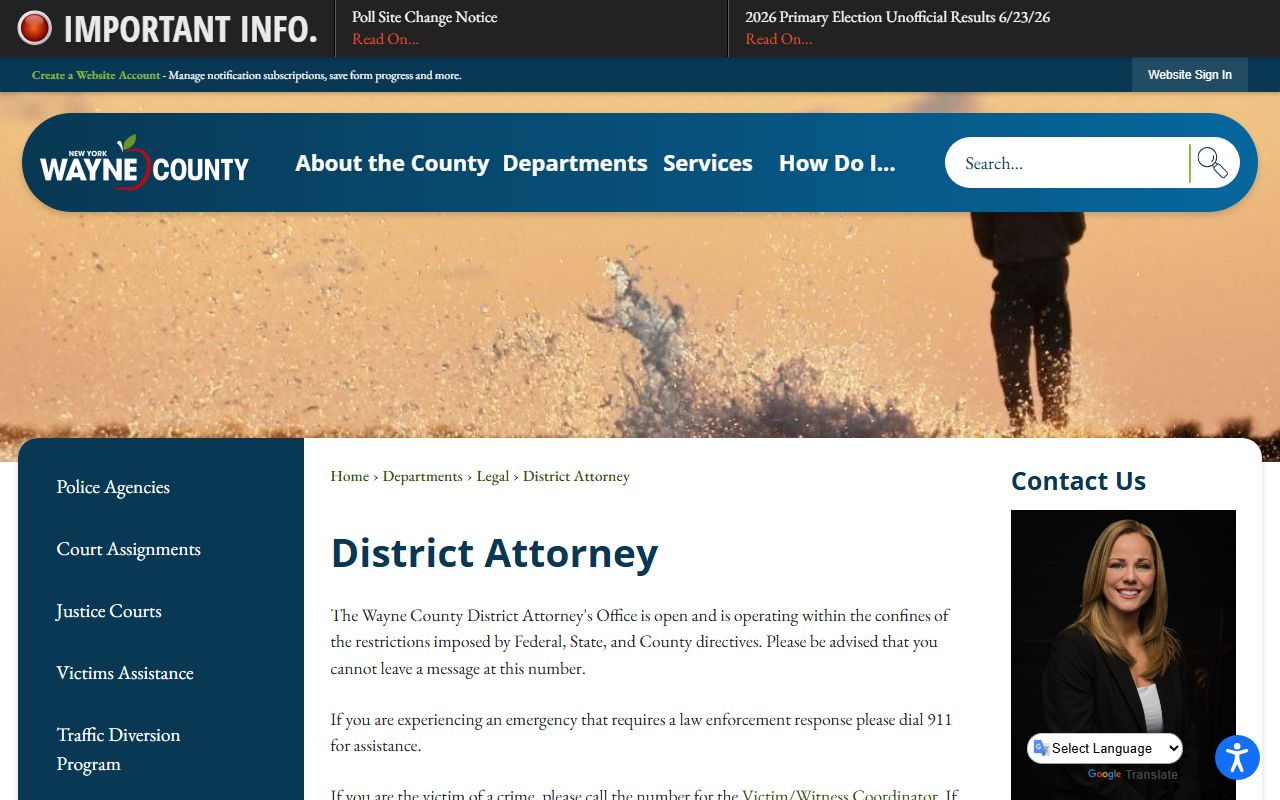
The DA source supports the local charging context, while the court portal supplies the searchable case record.
Search WebCriminal Court Records
New York Unified Court System WebCriminal is the main public case-search path named in the research for Wayne County court records after an arrest. It is separate from the sheriff's inmate search. Use the jail roster first only when the goal is current custody confirmation or the exact spelling of the person's listed name. Then move to WebCriminal to review the case record, charge list, court, case identifier, and public status information.
- Confirm the name through the Wayne County inmate search if the person may still be in local custody.
- Open WebCriminal Defendant Search and enter first and last name. Select Wayne County Court (M-B) if narrowing helps.
- Use WebCriminal Case Identifier Search when the case number or summons number is already known.
- Compare court charges against roster charges. Booking language may be brief, early, or incomplete.
- If a case is expected but missing, search again later or contact the court clerk, since WebCriminal notes update delays for some cases.
The WebCriminal Defendant Search page has two name paths and an output choice. The court dropdown includes Wayne County Court (M-B), but a wider search can help when the first court is not clear.
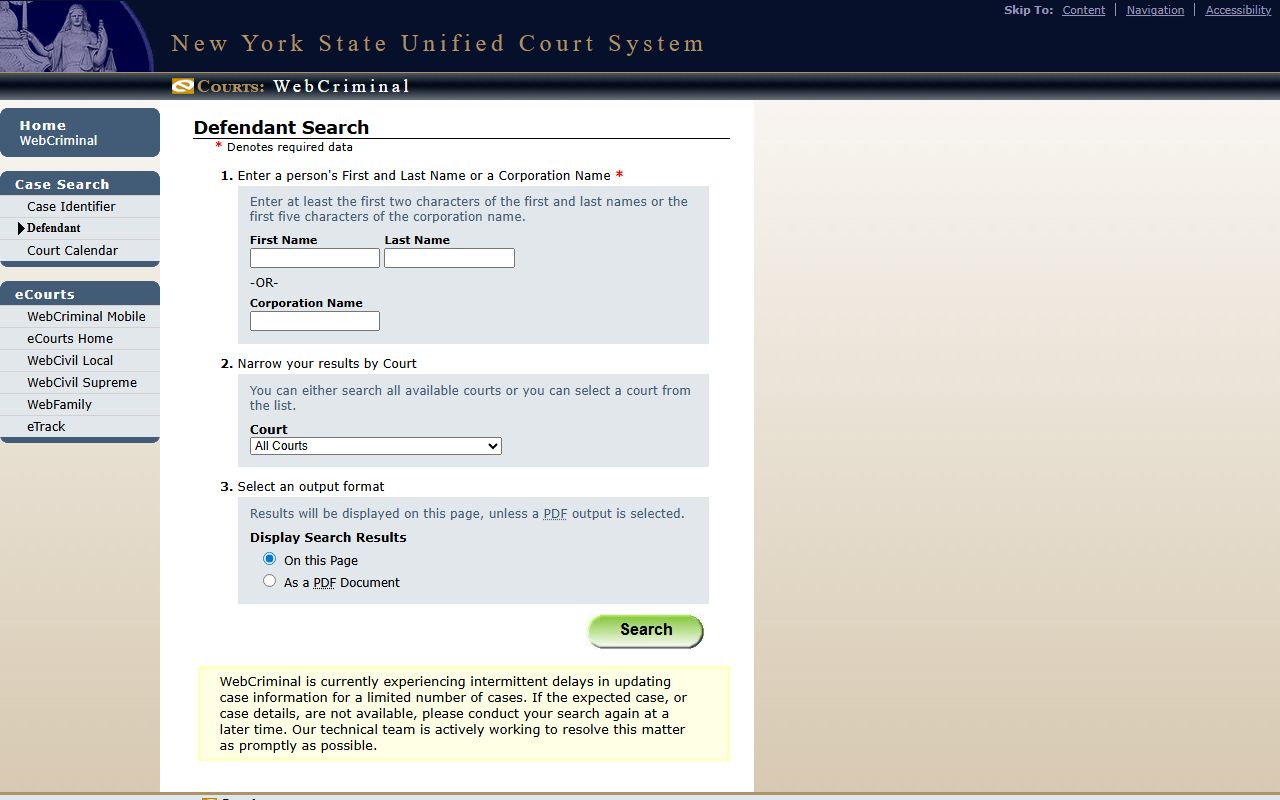
Defendant search is the best starting point when the person is known but the case number is not.
| Field Label | Type | Required | Notes |
|---|---|---|---|
| First Name | Text | Required with last name unless corporation name is used | Enter at least the first two characters. |
| Last Name | Text | Required with first name unless corporation name is used | Enter at least the first two characters. |
| OR Corporation Name | Text | Alternative path | Enter at least the first five characters. |
| Court | Dropdown | Optional | Includes Wayne County Court (M-B) among statewide choices. |
| Display Search Results On this Page | Radio | One output required | Shows results in the browser. |
| As a PDF Document | Radio | One output required | Creates a PDF result. |
The WebCriminal Case Identifier Search page is faster when the case number or summons number appears on a court notice, bail receipt, attorney letter, or prior search result.
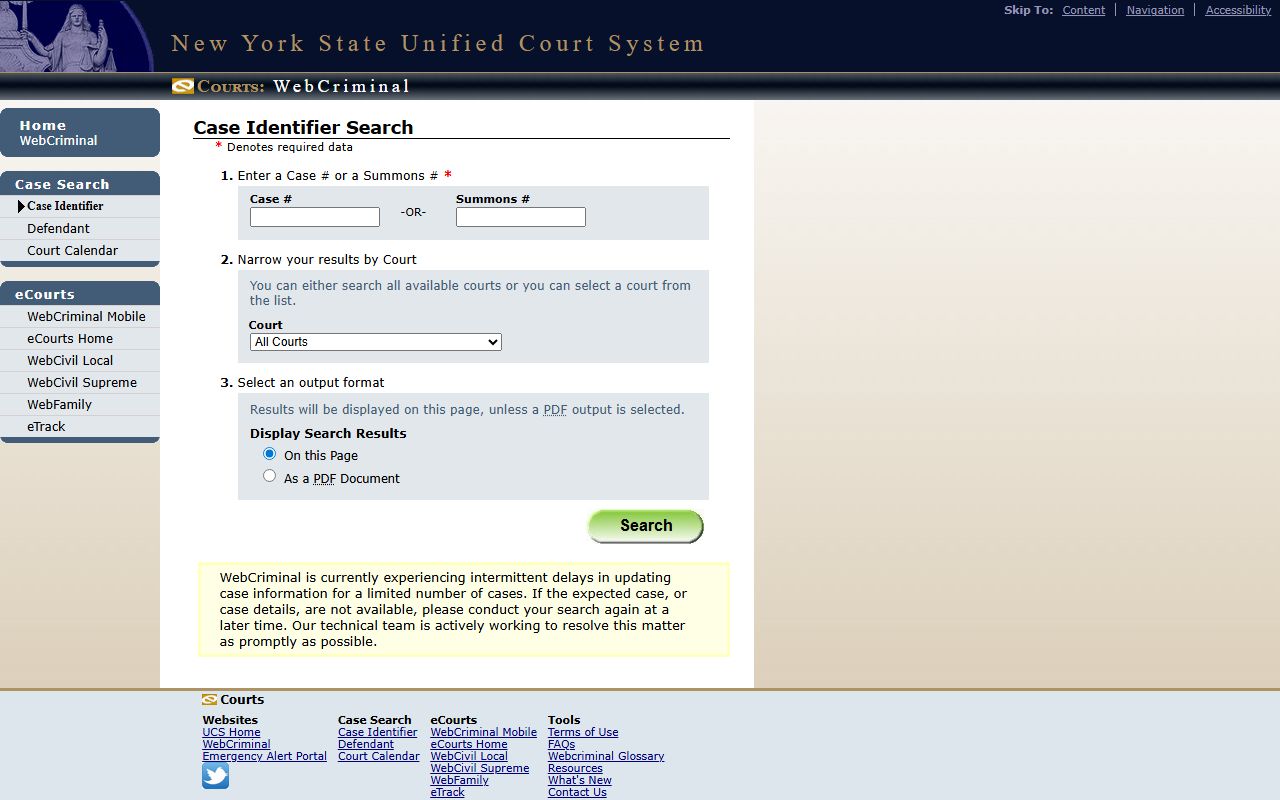
Case identifier search reduces name-match errors, especially when common last names return more than one record.
| Field Label | Type | Required | Notes |
|---|---|---|---|
| Case # | Text | Required unless summons number is used | Use the exact known case number. |
| OR Summons # | Text | Alternative path | Use when the summons number is known. |
| Court | Dropdown | Optional | Includes Wayne County Court (M-B). |
| Display Search Results On this Page | Radio | One output required | View results in the browser. |
| As a PDF Document | Radio | One output required | Generate PDF output. |
Charging Documents After Arrest
Charges after a Wayne County jail arrest can appear in more than one form. A complaint or information may begin a criminal prosecution, while an indictment reflects grand-jury action in a felony matter. These documents do not mean the same thing as a conviction. They are accusatory instruments, meaning they state what the government alleges and set the case in motion. The court record may later show amendment, reduction, dismissal, plea, trial, sentence, or sealing.
| Document | Who Uses It | What It Does | Wayne County Record Point |
|---|---|---|---|
| Complaint | Police or prosecutor | Starts many criminal matters with sworn allegations. | May closely follow arrest and booking facts. |
| Information | Prosecutor | Serves as a formal accusatory instrument for many prosecutions. | Can replace or refine early charge wording. |
| Indictment | Grand jury | Charges felony counts after grand-jury action. | Often changes how felony charges appear in the court record. |
The District Attorney decides what to prosecute within the limits of New York law and court rulings. A sheriff roster card may say "View Charges," but the court file is the better source for the live prosecution posture.
Wayne County Charge Status
Charge status can change more than once after arrest. A count may be pending at arraignment, reduced during negotiation, amended after review, dismissed by the court, or resolved by plea or verdict. The word "charge" means an accusation is in the court record. It does not prove guilt. Check the status of each count, not just the headline offense, because some cases contain several counts with different outcomes.
| Status | Plain Meaning | How to Read It |
|---|---|---|
| Pending | The case or count has not reached final disposition. | Look for the next appearance, bail order, or court action. |
| Amended | The wording or count changed after filing. | Compare earlier booking text with the current court charge. |
| Reduced | The offense level or charge severity was lowered. | Do not rely on the arrest charge alone. |
| Dismissed | The count ended without conviction on that count. | Sealing may apply if the case ended in favor of the accused. |
| Convicted | A plea or verdict found guilt on the count. | Read the sentence and disposition date, if public. |
Bail Records After Arrest
New York Criminal Procedure Law section 510.10 governs securing orders after arrest. The court must make an individualized decision about recognizance, nonmonetary conditions, bail, or remand where future attendance is required. The statute tells the court to consider factors such as the person's history, charge, prior court appearances, financial circumstances, firearm history, order-of-protection issues, and other risk or safety facts. It also gives the person a right to counsel when release is considered or reviewed.
Wayne County's jail FAQ gives local bail payment methods. Cash can be brought to the jail. Credit cards are accepted when the cardholder is present. Remote payment may be made through GovPayNet online or by phone. The court of jurisdiction returns bail money, and that court appears on the receipt. A local bail payment may still not release a person if another agency, parole or probation authority, court, federal agency, or immigration process has a hold.
| Release Type | How It Works in New York |
|---|---|
| Recognizance | No money is posted; the person promises to return to court. |
| Nonmonetary conditions | The court may impose supervision or conditions when allowed. |
| Cash or credit-card bail | Wayne County FAQ allows cash and in-person credit-card payment at the jail. |
| Bond or surety | New York recognizes bond forms when monetary bail is legally available. |
| Remand or hold | The person remains in custody by court order or another agency detainer. |
Note: Bail information can change quickly after a court appearance, so confirm the current order with the court or jail before paying.
Warrants and Court Records
A Wayne County warrant can lead to jail booking, and the later booking can lead to a court record after arrest. The sheriff's public site promotes a Most Wanted feature, but research did not locate a fielded active-warrant database for all Wayne County warrants. WebCriminal may show bench-warrant activity in a public criminal case, but it is not a complete warrant list. The safest route is to check the court of jurisdiction, the sheriff's office, or counsel.
Once a warrant arrest results in booking at Wayne County Jail, the person may appear in the sheriff inmate search if still in custody. The court record may update before or after the jail roster changes. Arrest warrants, bench warrants, fugitive warrants, and holds serve different roles, so one record source rarely tells the whole story.
Charges and Convictions Compared
A court record after a jail arrest often starts with charges, not a final result. That distinction is vital for fair reading. An arrest and charge show that a person was accused and brought into the court process. A conviction shows that a count ended with a plea or verdict of guilt. Some charges are dismissed, amended, reduced, sealed, or superseded by new documents.
| Point | Charge | Conviction |
|---|---|---|
| Stage | Accusation after arrest or filing. | Final or partial outcome after plea or verdict. |
| Proof | Based on charging standards and court process. | Requires guilty plea or proof beyond a reasonable doubt. |
| Record meaning | May remain pending, change, or end. | Can affect sentence, supervision, and criminal history. |
| Search caution | Read current status before drawing conclusions. | Confirm count, date, and sentence if public. |
Sealed Court Records After Arrest
New York law places limits on public access to some arrest, booking, and court records. Public Officers Law section 87 allows agencies to withhold or redact law-enforcement records when disclosure would interfere with investigations or court proceedings, impair fair-trial rights, identify confidential sources, reveal nonroutine techniques, or endanger life or safety. Public Officers Law section 89 treats arrest and booking photos as privacy-sensitive unless a specific law-enforcement purpose supports release. Criminal Procedure Law section 160.50 governs sealing after a criminal action ends in favor of the accused.
| Point | Sealed | Expunged or Limited Sealing |
|---|---|---|
| Public visibility | Public access is restricted by statute or court order. | New York more often uses sealing than total destruction. |
| Common trigger | Favorable termination, eligible disposition, or court order. | Eligibility depends on the law tied to the outcome. |
| Agency access | Some government or justice-system access may remain. | Access rules depend on the specific sealing statute. |
| Search result | A public search may return no case or less detail. | Missing results should not be treated as proof no event occurred. |
Criminal History Record Review
Public court searches are not the same as a full criminal-history record. New York DCJS provides a record-review process for people seeking their own statewide criminal-history information. That path is different from WebCriminal, the Wayne County jail roster, or a county records request. It is the better fit when the person wants a subject-of-record review, expungement or sealing FAQ material, or a certified view of personal history.
Important: Private record lookups are not consumer reports, and record information may not be used for FCRA-covered screening.